Tracing Patterns for Preschool: A Fun Way to Build Pre-Writing Skills
Before children begin writing letters and numbers, they need time to practice the basic movements that support early handwriting. Lines, curves, waves, zigzags, loops, and simple paths all help children develop the control they need to hold a pencil, follow a direction, and move their hand with purpose.
This is where tracing patterns become an important part of early learning.
Tracing activities are simple, but they build several important skills at the same time. When a child follows a line from start to finish, they are not only practicing pencil movement. They are also learning direction, focus, hand-eye coordination, and patience.
Why Tracing Patterns Matter?
Tracing patterns are often one of the first steps in pre-writing practice. They help children prepare for the movements used later in letters, numbers, shapes, and drawing.
For example:
Straight lines help children practice control and direction.
Curved lines prepare children for rounded letters and shapes.
Zigzag lines build attention and hand movement flexibility.
Wavy paths help children practice smooth pencil motion.
Matching paths encourage children to follow visual clues and complete a task.
These activities are especially helpful for preschool, kindergarten, and early elementary learners who are still developing fine motor skills.
Building Fine Motor Skills
Fine motor skills are the small muscle movements used in the hands and fingers. Children need these skills for writing, cutting, coloring, buttoning clothes, using tools, and many classroom activities.
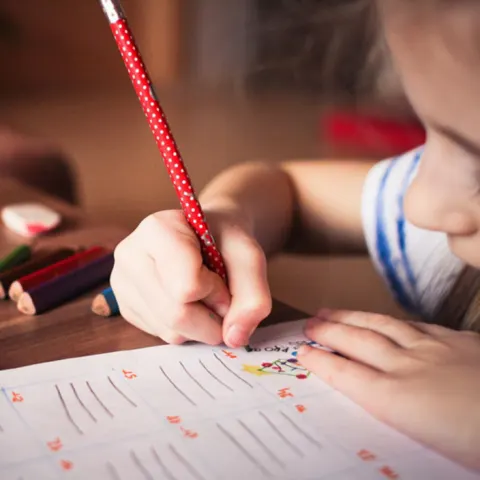
Tracing worksheets give children repeated, low-pressure practice with pencil control. By tracing different paths, children strengthen their hand muscles and learn how to control pressure, direction, and movement.
A good tracing activity should be clear, simple, and developmentally appropriate. It should not overwhelm the child with too many details. Instead, it should guide the child step by step.
Guided Tracing with Start and Stop Points
One helpful feature in tracing activities is the use of clear start and stop points. When children know where to begin and where to stop, the activity becomes easier to understand.
Start dots, arrows, and stop dots help children:
Follow the correct direction
Stay on the path
Complete the activity with more confidence
Develop better visual tracking
Understand that writing has a beginning and an ending point
This type of guided tracing is especially useful for young learners who need extra structure.
Why Difficulty Levels Help?
Not all children are at the same level. Some children are ready for simple straight lines, while others can handle curves, zigzags, and more challenging paths.
Using difficulty levels makes tracing practice more flexible. A child can begin with easier activities and move gradually toward more challenging ones.
This helps teachers and parents choose the right activity without making the child feel frustrated. It also gives children a clear sense of progress.
How to Use Tracing Patterns at Home or in the Classroom?
Tracing patterns can be used in many simple ways:
As a morning activity
During fine motor centers
As part of pre-writing practice
For homework
During small group instruction
As a calm activity before writing lessons
For extra practice at home
For best results, ask the child to trace slowly and carefully. Encourage them to follow the full path, start at the beginning point, and stay as close to the line as possible.
Children can also repeat the activity with different colored pencils or markers to make the practice more engaging.
A Printable and Interactive Resource
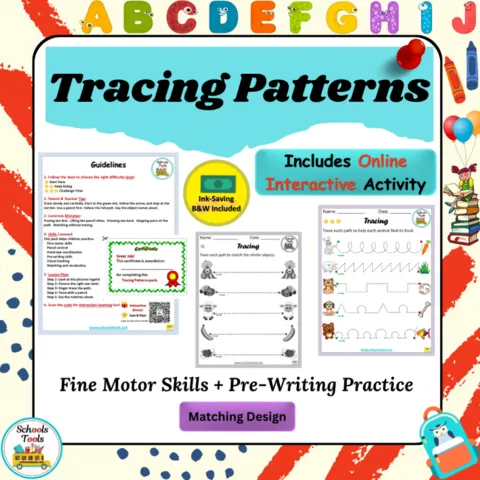
The Tracing Patterns Activity Pack from Schools Tools was designed to support young learners through clear, organized, and engaging tracing practice.
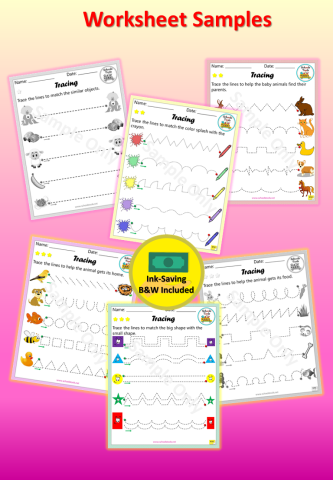
This resource includes printable worksheets, color and black-and-white ink-saving versions, 3-star difficulty levels, guided start and stop points, a teacher quick-start guide, progress tracking pages, certificates of completion, and an interactive QR activity bonus.
It is suitable for preschool, kindergarten, early learners, classroom centers, fine motor practice, homework, and at-home learning.
Watch the Product Video
Take a quick look at the Tracing Patterns Activity Pack and see how the printable worksheets, guided tracing pages, progress tools, certificates, and interactive QR activity work together to support early pre-writing practice.
What’s Included in the Tracing Patterns Activity Pack?
The resource includes:
Printable tracing worksheets
Color + black-and-white ink-saving versions
3-star difficulty levels
Start and stop dots for guided tracing
Teacher quick-start guide
Small-group progress tracker
My Progress Stars assessment page
Certificates of completion
Interactive QR activity bonus
This makes it easy for teachers and parents to use the resource in different learning settings.
A Simple Way to Make Learning More Organized
One of the helpful parts of this resource is that it is not only a set of worksheets. It also includes progress pages and certificates, which help make learning more motivating and organized.
Progress tracking allows teachers and parents to see how a child is improving over time. Certificates can also give children a positive sense of achievement after completing the activities.
Final Thoughts
Tracing patterns are a simple but powerful tool in early learning. They help children build fine motor skills, pencil control, visual tracking, focus, and confidence before moving into formal writing.
With the right activities, tracing practice can be fun, structured, and meaningful.
Explore the Tracing Patterns Activity Pack and help young learners practice, trace, and grow with confidence.
Product Link:
Tracing Pattenrs Activity Pack
Schools Tools
Printable Resources + Interactive Learning
welcome
.6aa08d0.png)
Print • Play Online • Shop the Collection
Schools Tools creates connected learning collections for preschool and early elementary learners.
Each collection is available as a ready-to-print PDF and an interactive online activity. Selected learning collections also have matching classroom merchandise available separately from Design+.
From literacy, phonics, and early math to tracing, fine motor skills, puzzles, flashcards, and more, every resource is designed to make teaching easier and learning more engaging—on paper, on screen, and in the classroom.
One learning idea. Three ways to experience it.